

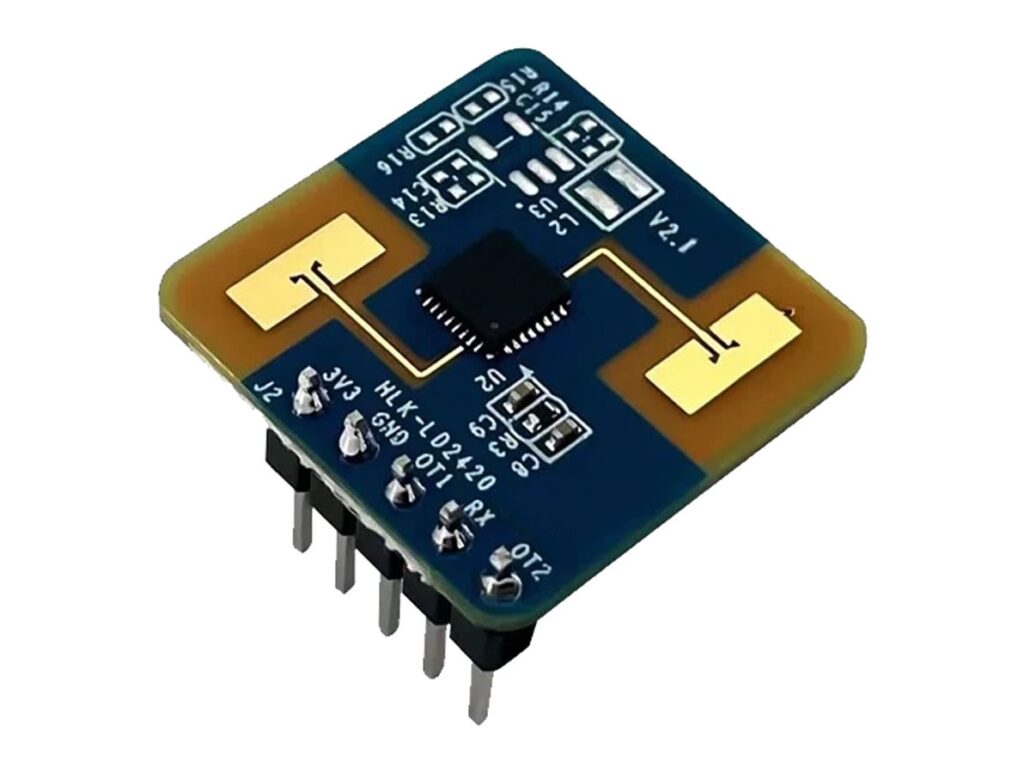
Master Invisible Detection: The Ultimate Guide to Touchless Sensors. Ever needed to detect people presence? let’s get to know the Hilink ultrasonic presence sensor, a neat little radio-waves-based human presence detection sensor, super simple to use.
According to its datasheet, it uses a 24GHz radar wave to detect moving or slightly moving bodies. For me that means that still bodies won’t be detected, but I have not tested it. Its detection range is up to 8 meters (and up to 60 degress), preferably upside down or at least horizontally.
There are a couple of different technologies when it comes to detect human presence. The most well-known and widespread is the infrared one. Such technology makes use of a sensor which is sensible to body (or objects) temperature. Temperature that is irradiated by means of infrared waves from (for example) human bodies.
In theory such infrared sensors are also sensible to smaller animals, like cats and dogs. Specifically since they also emit heat just like us humans. Most modern infrared presence sensors have a small potentiometer to regulate its sensitiveness. One main disadvantage of such sensors is they will not work well in external environments, due to solar radiation.
That brings our HLK-LD2420 sensor into the field. Being an ultrasonic sensor, it is worried the most about shapes, not body temperature or solar radiation. That makes it not care about the installation location as much. It can also be adjusted for body size, so no animals are detected.
How does it work and configurations
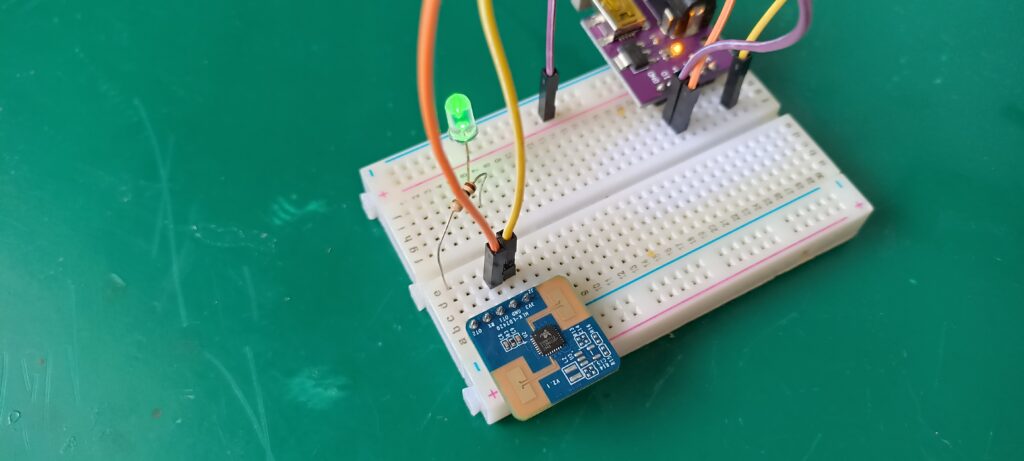
The most basic usage of this sensor is to connect an LED (or a microcontroller) on pin OT2, besides supplying it with 3V3 and GND. See the picture below for a reference test design. Resistor can be anything between 220 Ohm and 2k2 Ohm.
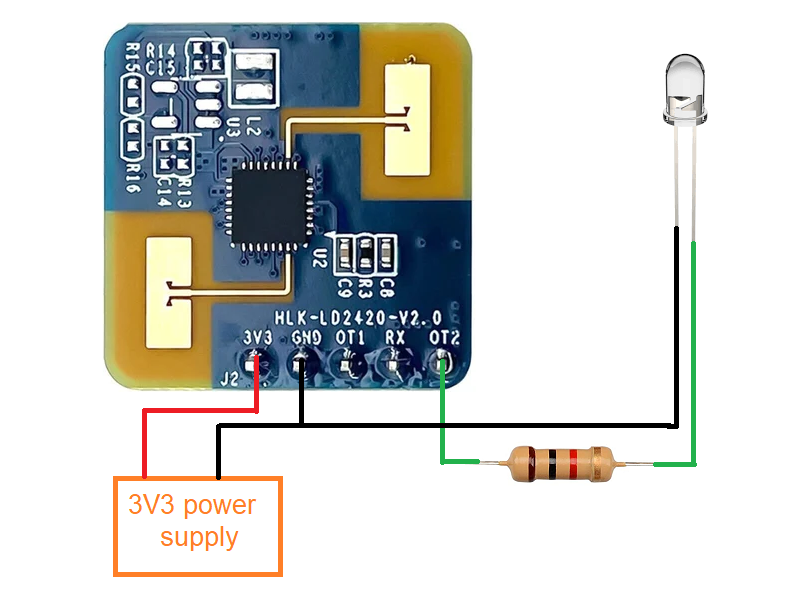
Now there is a single configuration you need to make (there are others, but are not necessary), which is the sensor detection high level time. It is the time the output will remain on after the last human presence detection; stardard value is 30 seconds. We will change that to 5 seconds: first you need to download the HLK-LD2420 Tool from here.
Update: as of 12/2025 that link seems to be broken. I don’t really know where to find this software anymore, since this seems to be a one-off type of product. That is, whose company did it once and forgot, or something like that. At the end of the day, this is Aliexpress.
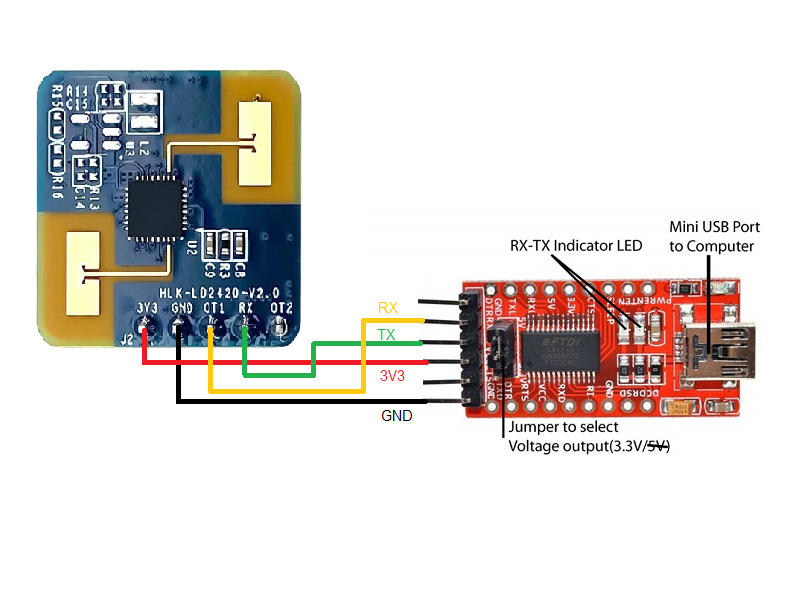
You are going to need a USB to Serial converter, the likes of the FT232 of the image below. Connect it like the image suggests and plug the USB into your computer.
After downloading and unzipping the software, click in “View/set param” at the top left. Select the COM port your USB to serial converter shows up at, then click “Connect”. Baud rate is 115200, no need to change.
tip: if your COM port changes you have to close and reopen the program again, it does not refresh.
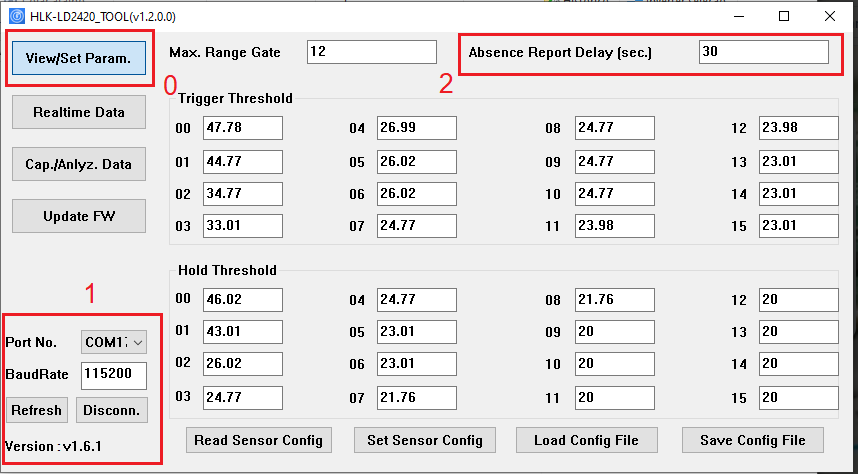
Then all you have to do is change the “Absence report delay” to a value your want; I choose 5 seconds. Then at the bottom of the screen click “Set sensor config” and “Save config file”. Now my sensor will keep its output ON for only 5 seconds after the last detection.
That configuration highly depends on what you want to do with the sensor. Also where you want to apply it, since shorter hold times may cause multiple detections to happen. Not that they would not happen with longer hold times, but you would just not see it. And that sometimes is what you want, some slower dynamic to avoid retriggers.
The Ultimate Guide to Touchless Sensors
You can see in the image below how simple the circuit is. I implemented it on a 400-point breadboard, but you can even do soldering or anything else. That is as long as you follow the schematic diagram mentioned above. That little purple circuit board you see on the top right is a voltage regulator. In my case I am connecting a mini-USB cable to it (5V) and making use of its internal LM1117-3.3 3.3V regulator.
Current consumption should not be a worry in our case, such ultrasonic sensor works under a few miliamps only (datasheet says 50 mA). One thing you should be worrying about, though, is if you use a low quality switch mode power supply. In that case some noise could come to the sensor via the 3.3V line and mess its logic function a bit.
If you ever start observing weird behaviours from the sensor, like false triggers, have a look at your power supply. Another point to observe is that these sensors will not like obstacles like walls and furniture. That means being careful where you are going to install it. Besides that, please do this experiment and tell me what you think later.
The Ultimate Guide to Touchless Sensors. I made a video explaining how this sensor work, below. Also if you want to buy it just click my affiliate link. If you want to know more presence sensors, also check this out.